Read a Nutrition Label Like a Pro
Walk into any grocery store and you'll find hundreds of products promising to be healthy, natural, high-protein, low-sugar, heart-healthy, organic, or made with "clean" ingredients. But how do you know what you're actually buying? The answer is simple: learn to read the Nutrition Facts label. You don't need a nutrition degree or hours of research. Once you understand a few key sections of the label, you can quickly compare products and make more informed choices for yourself and your family.
At The Grainery, we believe education is one of the most important parts of healthy living. Here's our guide to reading a nutrition label like a pro.
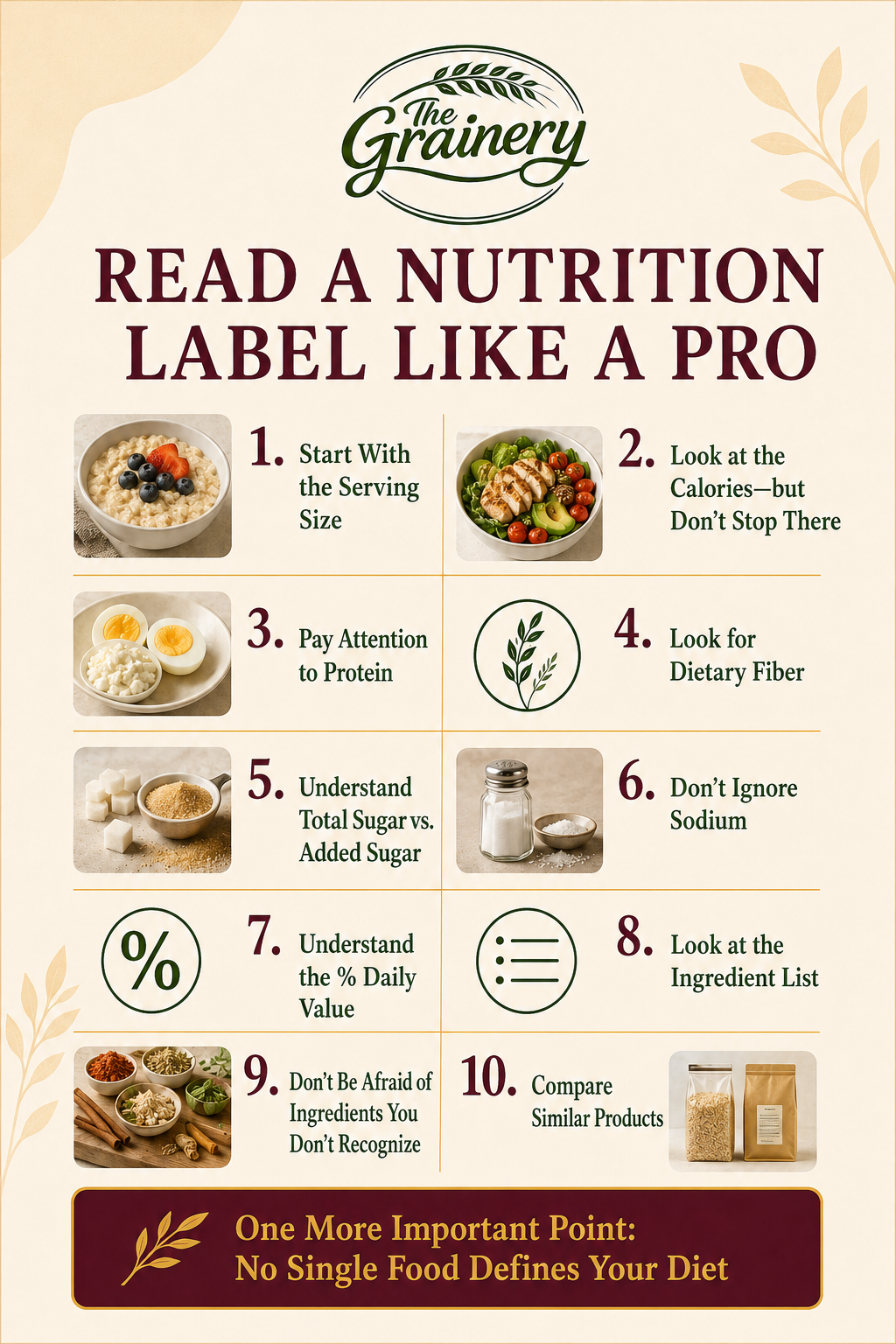
1. Start With the Serving Size
This is the first place you should look.The Nutrition Facts panel lists calories and nutrients based on the serving size shown on the label. The serving size isn't necessarily a recommendation for how much you should eat—it is a standardized reference amount based on typical consumption.
For example, imagine you pick up a granola that lists:
Serving size: ½ cup
If you pour a full cup into your bowl, you've eaten two servings. That means you need to double everything on the label:
Calories
Fat
Carbohydrates
Sugar
Sodium
Protein
Fiber
This is one of the most common mistakes people make when reading labels.
Pro Tip:
Before looking at calories or ingredients, ask:
"How much am I actually going to eat?"
Then compare that amount with the serving size.
2. Look at the Calories—but Don't Stop There
Calories tell you how much energy you're getting from one serving. The FDA uses 2,000 calories per day as a general reference for nutrition advice, but individual calorie needs vary based on factors such as age, body size, and activity level. Rather than labeling a food simply "good" or "bad" because of its calorie count, consider the entire nutritional picture.
For example, a food with 200 calories might provide:
10 grams of protein
6 grams of fiber
Healthy fats
Vitamins and minerals
Another 200-calorie food might provide very little nutritional value.
Calories are one piece of the puzzle—not the entire puzzle.
3. Pay Attention to Protein
Protein is important for maintaining and repairing tissues and is especially valuable for people who exercise regularly, older adults, and anyone trying to build balanced meals. When comparing similar products, look at the protein per serving.
For example, when choosing yogurt, compare:
Yogurt A: 8 grams of protein
Yogurt B: 18 grams of protein
If protein is a priority for you, that's a significant difference.
Don't automatically assume that a product with a "high protein" claim is the best choice, though. Check the complete label and ingredient list.
4. Look for Dietary Fiber
Fiber is another nutrient worth paying attention to.
Foods naturally rich in fiber include:
Beans
Lentils
Fruits
Vegetables
Whole grains
Nuts
Seeds
The FDA identifies dietary fiber as a nutrient consumers should generally seek more of, and its general guide considers 20% Daily Value or more per serving to be high. When comparing similar products, a higher-fiber option can often be a smart choice.
5. Understand Total Sugar vs. Added Sugar
This is one of the most useful updates to the modern Nutrition Facts label. Total Sugars include both naturally occurring sugars and added sugars. For example, the sugar naturally found in milk and fruit counts toward total sugars.
Added Sugars are sugars added during processing or preparation. The label now lists added sugars separately, making it easier to understand how much sugar has been added to the product. This doesn't mean every food containing sugar is unhealthy. An apple contains natural sugar, but it also provides fiber, vitamins, minerals, and other beneficial compounds.
The key is understanding where the sugar comes from and how much you're consuming.
6. Don't Ignore Sodium
Sodium is another nutrient that deserves attention. Many packaged and prepared foods can contribute significant amounts of sodium to the diet. The FDA's general guide considers 20% DV or more to be high. When comparing similar products, look at the milligrams of sodium and the % Daily Value.
For example:
Soup A: 700 mg sodium
Soup B: 350 mg sodium
If everything else is similar, Soup B may be the better everyday choice for someone trying to reduce sodium intake.
7. Understand the % Daily Value
The % Daily Value (%DV) helps put a nutrient amount into context. You don't have to calculate anything.
A simple FDA guideline is:
5% DV or less = low
20% DV or more = high
For nutrients you generally want more of—such as dietary fiber, vitamin D, calcium, and potassium—you can look for higher %DV values. For nutrients you may want to limit—such as saturated fat, sodium, and added sugars—you can generally look for lower %DV values.
Remember:
The %DV is based on the serving size, not necessarily the entire package.
8. Look at the Ingredient List
The Nutrition Facts panel tells you how much of various nutrients are in the product. The ingredient list tells you what the product is actually made from. Ingredients are generally listed in descending order by weight, meaning the ingredients present in the greatest amounts appear first. When you're comparing products, look beyond the marketing on the front of the package.
A package might say:
"Whole Grain"
or
"Natural"
or
"Made With Real Fruit"
Those statements don't tell you everything about the product.
Turn the package around and read the ingredient list.
9. Don't Be Afraid of Ingredients You Don't Recognize
One common mistake is assuming that an ingredient with a complicated name must be unhealthy. That's not necessarily true. Some legitimate food ingredients have scientific names that may look unfamiliar. Instead of judging an ingredient based solely on its name, consider the entire ingredient list and nutritional profile.
The goal isn't to find a product with the fewest ingredients at all costs.
The goal is to choose foods that fit your nutritional needs and preferences.
10. Compare Similar Products
Here's where you can really start reading labels like a pro. Don't compare a granola bar with a bag of almonds.
Compare:
Granola bar vs. granola bar
Yogurt vs. yogurt
Bread vs. bread
Pasta sauce vs. pasta sauce
Then compare:
Serving size
Calories
Protein
Fiber
Added sugar
Sodium
Saturated fat
Ingredient list
If serving sizes are different, keep that in mind before deciding which product is "better."
One More Important Point: No Single Food Defines Your Diet
Healthy eating isn't about finding the "perfect" food. It's about your overall eating pattern. A balanced diet can include fresh fruits and vegetables, whole grains, lean proteins, healthy fats, dairy or alternatives, beans, nuts, seeds, and occasional treats.
Instead of asking:
"Is this food healthy?"
Try asking:
"Does this food fit into the way I want to eat?"
That small change in perspective can make healthy eating much more sustainable.
Reference: U.S. Food & Drug Administration (FDA)