

Walking down the supplement aisle can feel overwhelming, even for someone who has been taking vitamins for years. Shelves are filled with colorful bottles promising energy, immune support, digestive health, better sleep, and improved athletic performance. While these products may contain useful nutrients or other dietary ingredients, the information printed on the front of the bottle does not always tell the complete story. Learning how to read a supplement label is one of the most valuable skills you can develop when making decisions about your health.
At The Graninery Healthy Habits, we believe that informed customers are empowered customers. Understanding what is inside a supplement, how much of each ingredient it contains, and how the product fits into your individual needs can help you make thoughtful decisions. The goal is not to find the supplement with the longest ingredient list or the most impressive marketing language. Instead, it is to understand the facts behind the product and determine whether it is appropriate for you.
Start With the Supplement Facts Panel
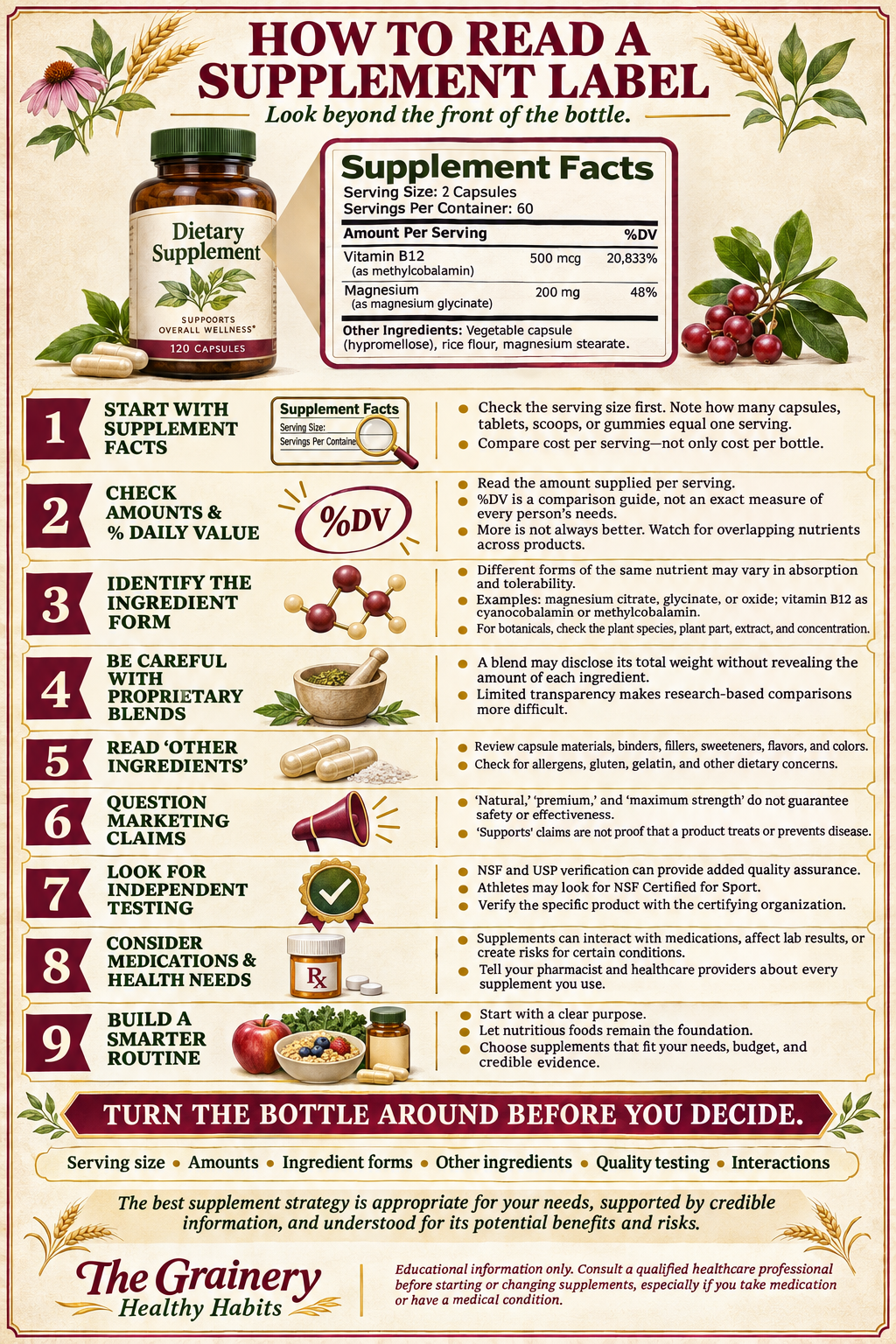
The most important place to begin is the Supplement Facts panel, which is usually located on the back or side of the bottle. Similar to the Nutrition Facts panel found on packaged foods, this section identifies the dietary ingredients in the product and provides information about their amounts.
The first item to examine is the serving size. This tells you how many capsules, tablets, scoops, gummies, or other units the manufacturer considers one serving. A bottle might advertise 500 milligrams of an ingredient, but that amount could require taking two or three capsules rather than one. If you overlook the serving size, you could misunderstand how much of an ingredient you are actually consuming.
The serving size also affects how long a bottle will last and how much the supplement costs per day. A bottle containing 60 capsules may provide 60 servings if the recommended serving is one capsule, but only 30 servings if the serving is two capsules. Comparing products based on cost per serving rather than cost per bottle can help you evaluate their value more accurately.
Once you understand the serving size, examine the individual nutrients or dietary ingredients listed underneath it. Pay attention to both the ingredient name and the amount supplied per serving. This information is more useful than relying on the product name or a prominent claim on the front of the package.
Understanding Daily Value Percentages
Many vitamins and minerals are listed with a percentage known as the Percent Daily Value, or %DV. This number indicates how much a serving contributes toward the Daily Value established for that nutrient.
For example, a supplement containing 90 milligrams of vitamin C provides 100% of the adult Daily Value. A product containing 45 milligrams provides 50%. These percentages offer a standardized reference for comparing products, but they should not be interpreted as an exact measurement of every individual's nutritional requirements.
Nutrient needs can vary according to age, sex, pregnancy, medical conditions, medications, and other circumstances. A person who has been diagnosed with a nutrient deficiency may have different requirements from someone who already obtains adequate amounts through food. Likewise, taking a supplement that provides several hundred percent of the Daily Value does not necessarily produce additional health benefits.
More is not always better when it comes to vitamins and minerals. Certain nutrients can cause adverse effects when consumed in excessive amounts, especially when several supplements contain overlapping ingredients. For example, a multivitamin, a separate mineral supplement, and a specialty wellness formula may all contain some of the same nutrients.
It is helpful to consider your total intake from foods, fortified products, and supplements rather than evaluating each bottle in isolation. A registered dietitian, pharmacist, or healthcare professional can help determine whether a particular dose is appropriate for your circumstances.
Know the Difference Between Ingredient Amounts and Ingredient Forms
Two supplements may contain the same general nutrient but use different chemical forms. Magnesium, for example, may appear as magnesium citrate, magnesium glycinate, magnesium oxide, or another compound. These forms can differ in their elemental magnesium content, absorption characteristics, tolerability, and intended applications.
When evaluating a mineral supplement, distinguish the amount of the actual mineral from the weight of the compound containing it. A Supplement Facts panel that lists magnesium as 200 milligrams generally refers to the amount of elemental magnesium, even when the mineral comes from a compound with a different total weight.
Vitamin B12 is another example of a nutrient that appears in multiple forms, including cyanocobalamin and methylcobalamin. Different forms are sometimes promoted as universally superior, but marketing claims should be evaluated against scientific evidence rather than accepted automatically.
Botanical supplements require additional attention because the plant species, plant part, extraction process, and concentration of particular compounds can influence what a product contains. A supplement made from a plant's root may differ substantially from one made from its leaves, even when both products display the same common plant name.
Understanding these distinctions can help you ask better questions and avoid assuming that products containing similarly named ingredients are necessarily interchangeable.
Be Careful With Proprietary Blends
One of the most confusing features of supplement labels is the proprietary blend. These blends combine several dietary ingredients under a single formula name, sometimes with an impressive-sounding description such as an energy complex, performance matrix, or botanical support blend.
Under U.S. labeling rules, a proprietary blend must identify its ingredients and disclose the total amount of the blend, but the label generally does not have to disclose the individual weight of each component. Ingredients must be listed in descending order of predominance by weight.
This means a product might contain a 1,000-milligram proprietary blend with five ingredients, but the label may not tell you how much of each ingredient is present. Without those individual quantities, it can be difficult to compare the product with research examining specific doses.
A proprietary blend is not automatically ineffective or unsafe, but limited ingredient transparency makes informed comparison more challenging. Whenever possible, consider products that clearly identify the amounts of important active ingredients, especially when those amounts are relevant to effectiveness or safety.
Read the Other Ingredients Section
After examining the Supplement Facts panel, look for the section labeled Other Ingredients. This area lists ingredients used in manufacturing or formulating the product that are not declared as dietary ingredients in the Supplement Facts panel.
Depending on the supplement, this section may include capsule materials, binders, fillers, sweeteners, flavors, coloring agents, and other substances. These ingredients can serve practical purposes, such as helping a tablet maintain its shape, improving flavor, or protecting the contents of a capsule.
The presence of an unfamiliar ingredient does not automatically mean that a product is harmful. However, reviewing the full ingredient list can be especially important for individuals with food allergies, intolerances, dietary restrictions, or preferences about certain additives.
People with celiac disease, for example, may need to verify a product's gluten-free status, while someone with a food allergy should carefully review allergen information and contact the manufacturer when the labeling is unclear. Consumers who avoid animal-derived ingredients may also need to check whether capsules contain gelatin or plant-based materials.
Understand What Marketing Claims Really Mean
Supplement packaging often includes statements such as "supports immune health," "promotes relaxation," or "supports healthy joints." These are commonly known as structure/function claims because they describe how an ingredient may affect normal structures or functions of the body.
It is important to understand that these claims are not the same as proof that a product can treat or prevent a disease. Under federal law, dietary supplements generally cannot legally be marketed with claims that they diagnose, treat, cure, or prevent diseases.
You may have noticed a disclaimer stating that a product's claims have not been evaluated by the Food and Drug Administration. This language is required for certain dietary supplement claims and helps distinguish those statements from FDA-approved drug claims.
Unlike prescription medications, dietary supplements are not generally reviewed and approved by the FDA for safety and effectiveness before they are marketed. Manufacturers are responsible for meeting applicable requirements, and the FDA has authority to take action against products that are adulterated or misbranded.
Terms such as "natural," "premium," or "maximum strength" should not be treated as guarantees of safety or effectiveness. A naturally occurring substance can still cause side effects or interact with medications, and a higher dose is not automatically more beneficial.
Look for Independent Quality Testing
Quality is another important consideration when choosing supplements. Independent certification programs can provide additional assurance that a product meets specific testing and manufacturing standards.
Organizations such as NSF and USP offer verification programs that evaluate certain aspects of supplement quality, including ingredient identity, label accuracy, manufacturing standards, and selected contaminants. The precise requirements depend on the certification program.
For competitive athletes, NSF Certified for Sport is particularly relevant because it includes screening for substances prohibited in sports. This type of verification can help reduce the risk of exposure to certain undeclared ingredients, although no certification eliminates every possible risk.
Independent testing should not be confused with proof that a supplement produces a particular health benefit. A certified product may meet defined quality standards without being necessary or effective for every person.
When you see a certification symbol, verify that the specific product is actually listed by the certifying organization rather than relying on a logo alone.
Consider Medication Interactions and Personal Health Needs
A supplement may be sold without a prescription, but that does not mean it is appropriate for everyone. Vitamins, minerals, herbs, and other dietary ingredients can interact with prescription medications, affect laboratory results, or create risks for people with certain medical conditions.
Vitamin K, for example, can interfere with the management of warfarin therapy when intake changes substantially. Other supplements may affect blood pressure, blood sugar, sedation, or the way medications are processed by the body.
People who are pregnant, breastfeeding, preparing for surgery, managing chronic medical conditions, or taking multiple medications should be especially careful when introducing supplements.
It is also important to tell your healthcare providers about every supplement you use. Keeping an updated list of product names, ingredient amounts, and serving sizes can make it easier for your pharmacist or medical team to identify potential concerns.
Build a Smarter Supplement Routine
The best supplement routine begins with a clear purpose. Rather than purchasing a product because of a dramatic advertisement or a recommendation on social media, ask what nutritional need you are trying to address and whether the product has credible evidence supporting its intended use.
A balanced diet remains the foundation of good nutrition. Fruits, vegetables, whole grains, legumes, nuts, seeds, and appropriate protein sources provide combinations of nutrients that supplements cannot fully replicate. Supplements can be useful in certain circumstances, but they should generally complement rather than replace a nourishing eating pattern.
At The Grainery, we encourage customers to approach supplements with curiosity, realistic expectations, and an understanding of their individual needs. Taking a few extra minutes to examine serving sizes, ingredient forms, amounts, other ingredients, and independent certifications can make the supplement aisle much easier to navigate.
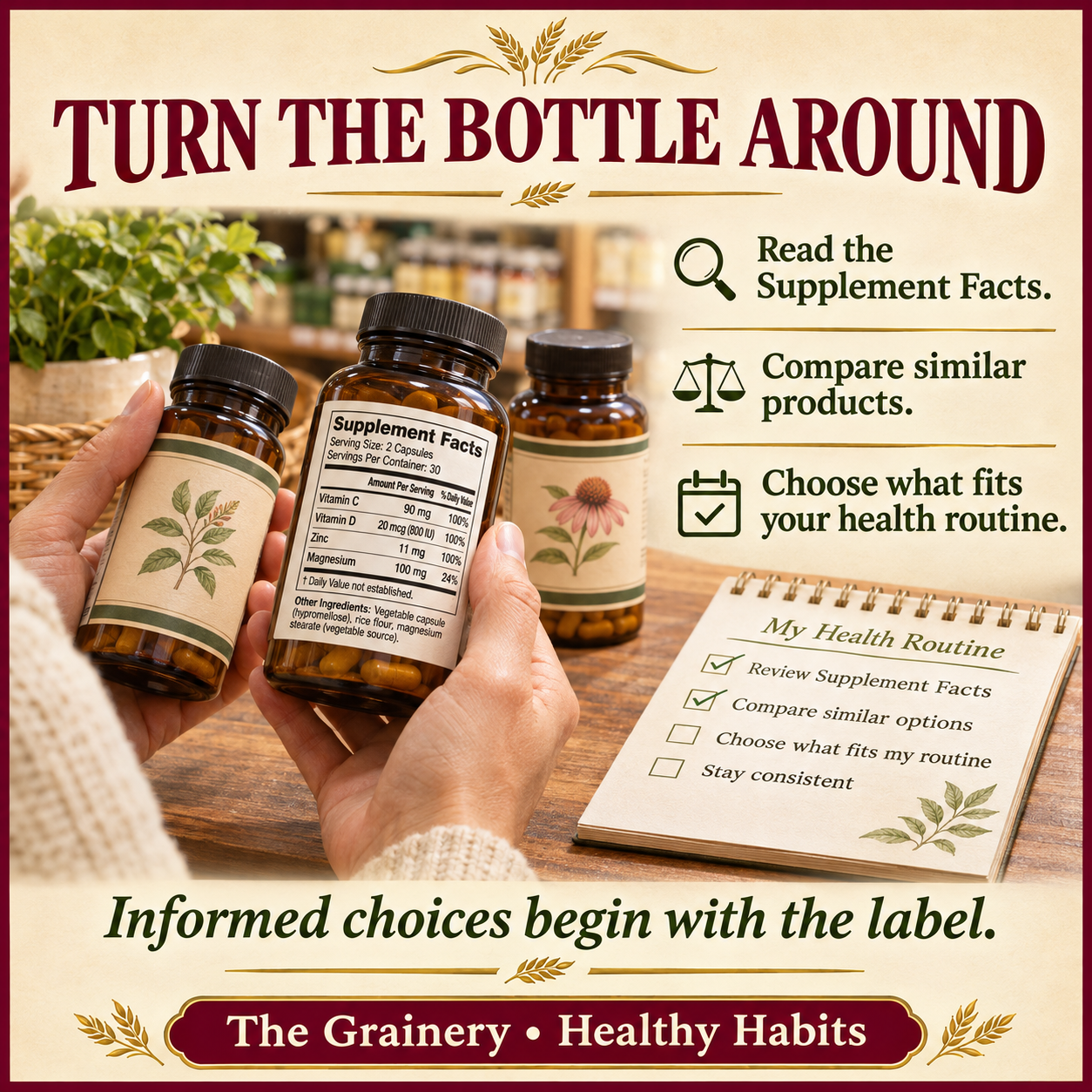
The next time you pick up a supplements bottle, turn it around before making a decision. Read the Supplement Facts panel, compare it with similar products, and consider how the ingredients fit into your overall health routine. When you understand what the label is telling you, you are better equipped to make informed decisions about what you put into your body.
Remember that the most effective supplement strategy is not necessarily the one with the most products. It is the one that is appropriate for your needs, supported by credible information, and used with an understanding of its potential benefits and risks.
Disclaimer: This article is for educational purposes and does not replace individualized advice from a healthcare professional. Consult a qualified healthcare provider before starting or changing supplements, particularly if you take medication or have a medical condition.
Full list of resources and further reading
1. FDA — Dietary Supplement Labeling Guide: Nutrition Labeling. Explains serving sizes, dietary ingredients, Daily Values, and Supplement Facts requirements. FDA labeling guide
2. NIH Office of Dietary Supplements — Dietary Supplements: What You Need to Know. Consumer guidance covering supplement ingredients, safety, labeling, and regulation. NIH consumer fact sheet
3. FDA — Label Claims for Conventional Foods and Dietary Supplements. Explains health claims, nutrient content claims, and structure/function claims. FDA label claims guidance
4. FDA — Structure/Function Claims Notification. Details the rules for certain dietary supplement claims and the required FDA disclaimer. FDA claims notification
5. NIH — Dietary Supplement Label Database. Searchable records of product labels, ingredient amounts, and manufacturer statements. Inclusion does not imply product approval or verification. Search supplement labels
